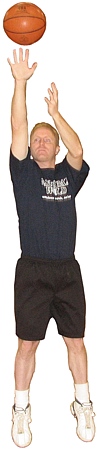
Shooting is the most important skill in basketball. The fundamental skills of passing, dribbling, defense, and rebounding may enable you to get a high percentage shot, but you must still be able to make the shot. A large part of shooting is mental attitude. In addition to shooting skill, you must have confidence in yourself to shoot well. The integration of the mental and mechanical aspects of shooting fosters shooting success.
Development of an accurate shot forces your defender to play you tight and become vulnerable to a fake, allowing you to pass and drive as well as shoot. If you lack an accurate shot, a defender can play back in anticipation of a drive or a pass and be less susceptible to your fake. When you do not have the ball, your defender can play farther off you and be in better position to give defensive help to a teammate guarding another player. To be successful, a team must have players who can make the outside shot.
Great shooters are often called pure shooters because they have a smooth, free-flowing shot or a soft touch. Some players think a pure shooter is naturally gifted - born that way. This is a misconception. Great shooters are made, not born.
Pure shooters, such as Steve Nash and Ray Allen, will drive hard around an opponent and then effortlessly pull up for a soft jump shot. They appear to have been born shooters. Their thoughts are not on the mechanics of the shot, but rather on the position and movement of teammates and defenders. Pure Shooters consider faking the shot, delivering a pass, driving for the basket, or reversing direction to pull the ball out and reset the offense. For Steve Nash, Ray Allen and other great shooters, the skill is automatic. Like other talented people, pure shooters perform their skills to maximum level without conscious thought. Each was a beginner at one time, however, and each developed into a pure shooter through dedicated practice.
Shooting is a skill you can practice by yourself. Once you understand correct mechanics, all you need is a ball, a basket, and an eagerness to improve. But it is also helpful to practice shooting under game conditions, including the pressure situations that occur late in a game. Practice with a partner providing the defensive pressure of an opponent. Remember that through practice you will develop shooting skill and confidence. You also can benefit from having a trained observer such as a coach, teacher, or a skilled player watch you shoot and provide corrective feedback. However, most of your shooting practice will occur when a coach or teacher is not present, so learn to analyze your shot's reaction on the rim to reinforce successful execution or reveal shooting errors and their possible causes. |
|
|
Basketball Shooting - Confidence and Rhythm |
Basketball Shooting - Integrating the Mental and Mechanical |
Basketball Shooting - Errors and Corrections |
Basketball Shooting Lead-up Drills |
Make your shot automatic! Remember, the key to progress is daily practice. |
860-668-7162 • 888-812-5452 |
© Copyright 2014, Basketball World, Inc. All rights reserved. BASKETBALL WORLD is a registered trademark. Any use of the name or logo is prohibited by law.
All photographs, graphics, web design, and text contained within this site are protected by the U.S. and international copyright laws.
No portion of basketballworld.com may be duplicated, redistributed or manipulated in any form.
|
|